

It’s a safe bet that you don’t go on pilgrimage. Exhausted people rarely do.
And pilgrimage sounds like effort, even from a distance. So we aren’t drawn toward the idea. I mean, think back a few seconds to when you saw the word in the title of this essay. Right?
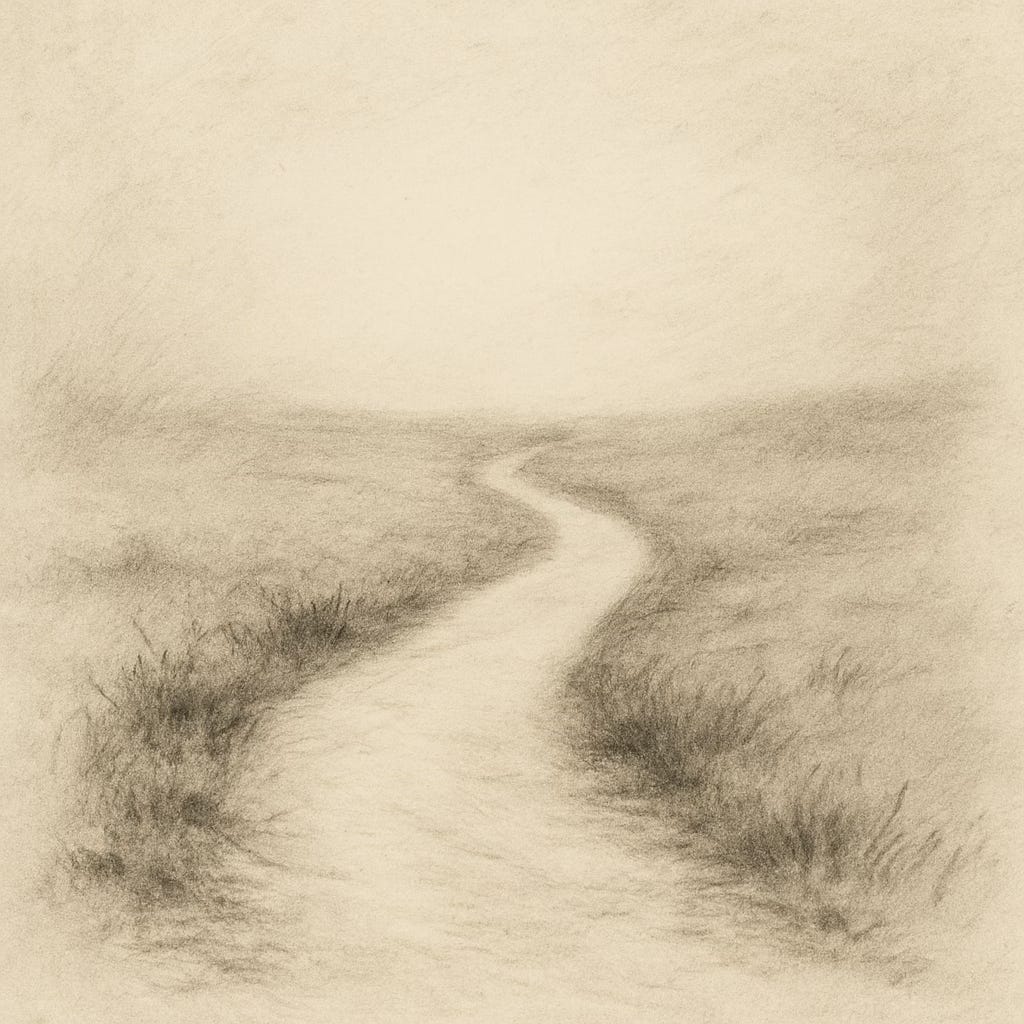
Think about the medieval pilgrim who walked for months on dusty roads, with blistered feet, and a good deal of housing uncertainty. They carried almost nothing—except the discomfort. And they viewed that as a kind of devotion. Getting to the shrine was important, of course, but what happened on the way was the real active ingredient.
Theoretically, we admire the pilgrim. We’ve read about the Camino de Santiago, and maybe have seen the documentaries. The archetype of someone walking along an ancient footpath is irresistible.
But importantly, we are not doing it. I am not doing it.
Because we’re tired and have jobs. We can’t take three months off to walk across Spain. Adding another “restorative” activity to our schedule isn’t compelling.
So we stay home. Because pilgrimage is for people with time and energy. And honestly, we wonder if it’s for people that have a different kind of faith than ours.
But what if we’re wrong about pilgrimage?
What Pilgrimage Does
We’re fine with tourism. Many of us love it. But tourism isn’t pilgrimage. When I’m a tourist I go to see things, and to take pictures of myself being there. I don’t do this just to portray something—or not only for that anyway. I take pictures to help me go back later mentally, and often with someone as I tell them about it. It’s the experience, and the pictures help others have the experience too, in a way.
But with a pilgrimage, if I understand it at least a little, it is the experience of becoming something, changing on the way there. That’s much harder to give to someone else through photos, although a very gifted photographer and narrator might give people a glimpse of it.
It’s like pilgrimage is even more selfish than tourism—and tourism can be pretty selfish. Pilgrimage is seeking something that can only be for the one on pilgrimage. Virtual pilgrimages, even if that term is used, are still never going to happen. Not in the real sense in which a pilgrim created it for themselves.
The medieval pilgrim didn’t walk to Canterbury just so they could be at Canterbury. They walked not just to put distance behind them. They were set on leaving parts of themselves behind them.
The moving toward a place intentionally, over a long period of time—that was the transformation.
Here’s what pilgrimage does that nothing else quite does:
Pilgrimage creates sacred distance.
Not from God but from yourself, your life as it is. You leave something and carry only the work of traveling from something, to something.
Pilgrimage removes choices.
Once you start walking, it’s a kind of entrainment that simplifies the map. The path becomes the only map you need. You aren’t deciding at every fork what to do. You walk. That’s it. The map is simple. You’re following it without the distraction of choice.
Pilgrimage makes the body the teacher.
Your legs hurt. You’re tired. The body can’t be ignored on pilgrimage. It won’t let you live in your head because your body keeps reminding you: You are here. You are flesh.
Pilgrimage strips away the constructed self.
On pilgrimage no one cares who you are back home. You’re just a walker. Your other identities no longer matter.
Pilgrimage creates hunger for arrival and rest.
After days of walking, you know what it is to long for the end. To ache for the place where you can finally stop. It’s a type of fasting from leisure and stillness.
And this is what the exhausted need. Not just rest, but an appreciation of rest and stillness.
Try this:
This week, take one small pilgrimage.
Walk somewhere with intention. Not for exercise but for sacred distance, a simpler identity, an appreciation of rest and stillness. And a feeling of a simple and continuous following.
It could be fifteen minutes. It could be an hour. It doesn’t matter. Go alone. Leave your phone behind, or at least silenced. Don’t listen to podcasts or music. Just walk.
And when you get there, stop. Be still. Ask who you are now, what you see as important, how it felt to follow in a simple obedience.
That’s pilgrimage.
That’s what the exhausted need.