

The thing I’m writing about today—I might be writing about it because I’m old. But if you’re not old, and you find it interesting too, then maybe this isn’t just about age. Maybe it’s about what we’ve all lost.
It’s true that life is a series of losses, but that doesn’t mean there aren’t things we need to hold on to. Life takes things from us, or we decide that we can no longer hold them.
But something else is happening now, something our ancestors didn’t do. We build our identity through rejection.
And in whatever we reject, a part of ourselves also gets lost.
I see this in the people I sit with, and I feel it in myself. We call it reinvention—letting go of fragments and threads that used to make up who we were. We even change our names, or some other part of the identity that was given to us.
We walk away from the career of our father, or the family business. We leave behind our faith, or our hometown. Lineage and inheritance matter less to us than self-definition and freedom.
So there is the thing we no longer believe, the thing we no longer tolerate, the thing we no longer see as beautiful or worth our time. There are the places we no longer go, the books we no longer read, the patterns of life we no longer follow.
We don’t want stagnation, so we try to build meaning from discontinuity. We dissolve and shed, and say we are not that, not them. Instead of our life unfolding, our story reads like a series of clean breaks.
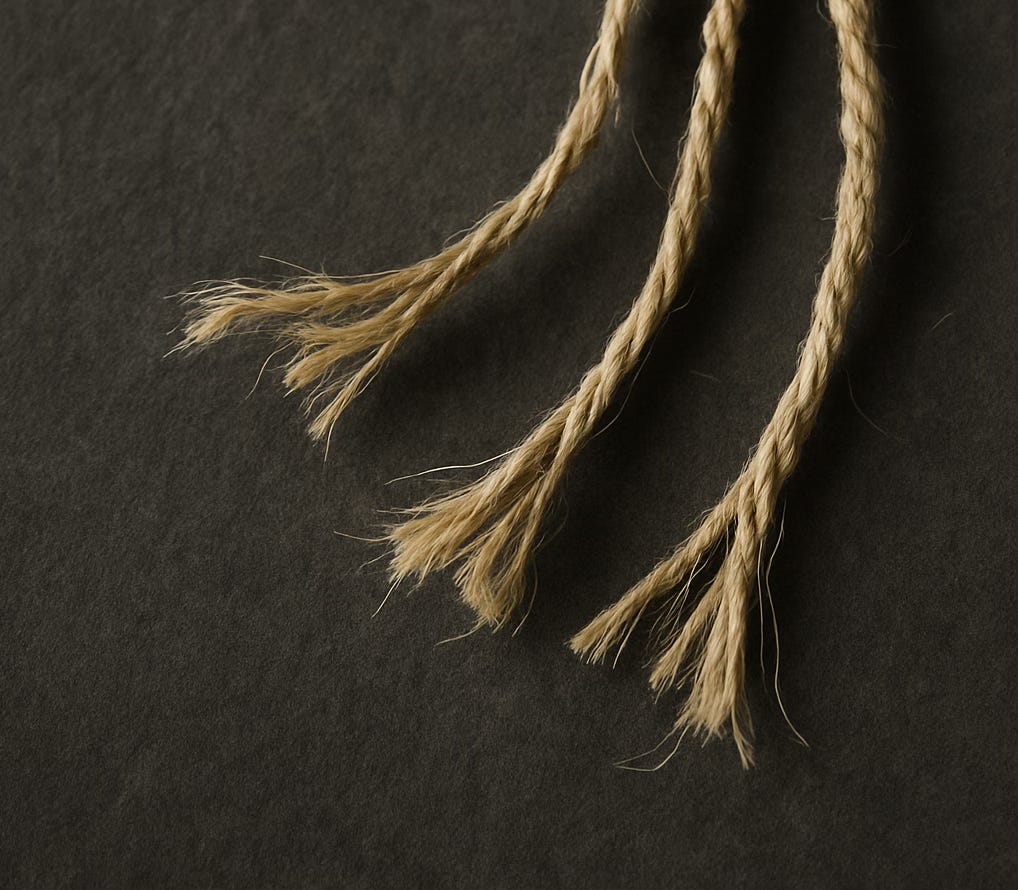
But in all of this, I notice something in myself and in others: we’re trying to weave, but without any thread.
Whatever we drop or cut off was a part of us.
And the saints, the psychoanalysts, and the poets all agree on this much: We can’t become whole by abandoning our fragments.
We’re now several centuries into what feels like a social experiment done without informed consent. And here is the research question: Can human beings live without an inherited something? Can we feel a sense of belonging to what we did not choose?
The answer may already be inside us—in burnout, anxiety, loneliness. We see it when we recognize that we’ve built a culture of orphaned selves. We birth things but don’t allow ourselves to be children of anything. We start from scratch, or tell ourselves we do, cutting off what came before and calling it progress.
The underlying sense of loss is the soul’s version of jet lag. It’s exhausting because we no longer believe any place is truly home— only a nicer Airbnb.
My answer is this: I’m not sure we can survive the crushing loneliness of believing the current version of us is all there is.
And when I think of the trail we’ve been on as a culture, I see how we’ve tried to survive the loss of others—other conscious beings that used to inhabit our ancestors’ enchanted world. Whether these were fairies, wood elves, spirits, imps, or angels, there was once a sense of not doing this alone.
And now, on top of losing even the possibility of that companionship, we have cut ourselves off from all that came before us— even within our own species, even within our own families.
So how do we practice continuity? How can we feel less orphaned?
Honestly, it’s not easy. A small voice inside warns us against binding ourselves to anything we had no say in. The longest stories that formed us were written without our consent or our knowledge. But the essential part of recovering continuity is noticing and owning the good and valuable threads that came before the current “us,” even if they were created by people and times in the distant past.
Some of these threads will be from other people, other centuries. And some will be threads from your own life—your own past. You may find a thread tangled around a life event you’d rather not remember.
A relationship you lost probably has a thread or two woven through it that is worth keeping. If you throw away the whole experience and try to cut it out of your life like missing audio tape, the thread is lost. You are unconnected.
We throw it all away by saying things like,
“I was a different person back then,”
or
“That’s just not my life anymore.”
These sentences feel reassuring, like a sign of growth. Often they are. But they are also accompanied by a subtle headshake—an unconscious *no*. And while we can grow, we don’t have to grow by rejection.
Think of sentences that begin with:
“What I held onto during that time was…”
or
“I’m glad that going into that difficult season, I had already learned…”
These alternatives name something that existed before, during, and after the event— a thread you can still claim.
The desert fathers and mothers practiced a simple daily remembering. They called it *keeping the mind in the heart*—a practice I’ll write more about another time. It wasn’t dramatic. Just a small turning toward continuity each morning.
I try to do something like that myself—just a moment of remembering that my life didn’t start with me and won’t end with me. Sometimes I imagine the “great cloud of witnesses.”
I also look for the concrete, earthy kinds of continuity that have no obvious spiritual marker but still carry a thread across generations. Maybe I choose a product still made the way it was generations ago, or I visit a family business that’s been passed down. Sometimes I touch a piece of structural wood in my basement that has been holding weight for over a hundred years.
I think about the craftsman who cut it, fitted it, trusted it to bear the load. His hands shaped this. My house stands because of his work.
Continuity is not a doctrine, even when (or if) it flows from doctrine. It’s a daily posture—a gesture that doesn’t just discard, but also holds and bears.
And of course, ritual is where continuity really starts to have weight.
A Small Ritual for Continuity
Each day, name one thread you carry.
Maybe it’s a practice someone taught you. Maybe it’s a phrase your grandmother said. Maybe it’s a prayer you still half-remember.
Name it.
Hold it consciously for a few breaths. You don’t have to obey it in an unexamined way. You don’t have to be bound by it as if the key has been thrown away.
Just acknowledge: **This was passed to me. I carry it forward.**
That’s all.
If we practice even one small act of remembering, the loneliness eases. And we feel that our story continues from somewhere and continues toward Someone.
We feel less like orphans when we find parts of our inheritance that we don’t need to reject.
At first I thought I was being given permission to toss out the hospice (meaning very institutional ) blanket I found leftover when Mom died.
But then I realized maybe there’s deeper work to do and this is about what I’m keeping. So the blanket goes. The morning Bible reading stays.
I do often think of the men who built my house. And how it was built the year of our wedding. Took us 14 years and 6 houses previous to find it.
Great post.